
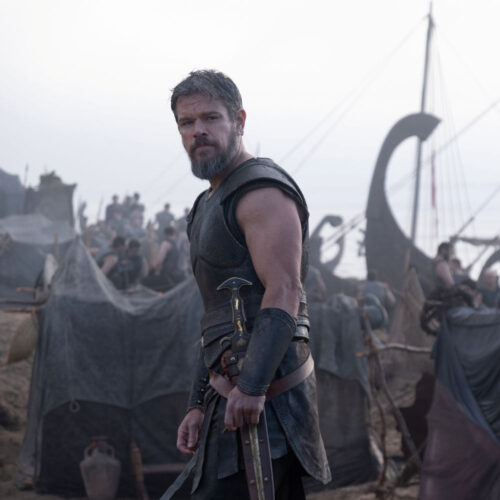
Matt Damon’s Odysseus faces a cyclops, nymphs, sirens and witches while trying to make his treacherous journey home to Ithaca.
After winning seven Oscars for Oppenheimer, Christopher Nolan was effectively given carte blanche to make whatever he fancied next. And he decided to take on the epic feat of adapting Homer’s centuries-old text, the Odyssey.
After working with Matt Damon on Interstellar and Oppenheimer, Nolan tapped him to play the warrior and king of Ithaca, Odysseus, in his latest movie.
After the Trojan War, Odysseus sets sail for Ithaca with his men, but ends up on a perilous 10-year journey in which they face a cyclops, nymphs, sirens, witches and much more.
His wife Penelope (Anne Hathaway) and their son Telemachus (Tom Holland) have been waiting for his return for almost 20 years, and their palace is filled with suitors (most predominantly Robert Pattinson’s slimy Antinous) with their eye on the empty throne.
However, the indignant Penelope refuses to remarry, confident that she will soon be reunited with her beloved Odysseus, and the suitors are plotting a new strategy.
Nolan has brought us films on a large scale before, but The Odyssey is on a whole new level. It’s mind-blowing how epic this spectacle is. The technical teams are firing on all cylinders, from Hoyte van Hoytema’s stunning cinematography to Ludwig Göransson’s dramatic score.
Nolan fans will know that he does not like to tell a linear story, so his faithful adaptation of Homer’s text is told out of chronological order and hops around in time and place constantly.
It can be quite difficult to keep track of where you are in the story, and the jumping back and forth between Ithaca, Odysseus’ journey, and his time with the nymph Calypso (Charlize Theron) really affects the momentum of the story.
However, his editing choices really pay off as the almost three-hour movie nears the end. He sticks the landing in the jaw-dropping final 30 minutes, where the non-linear storytelling packs a thematic punch.
But The Odyssey isn’t perfect. Because there is so much story to pack in, Nolan doesn’t let the film breathe before moving swiftly onto Odysseus’ next encounter with gods and monsters.
As a result, you might marvel at the visuals and filmmaking skill on display, but you may not be overly invested in the story itself. Nolan loses sight of the emotional core by trying to achieve such an ambitious film in terms of scale and scope.
Nolan has the power and prestige to get major A-list stars in his films, even for tiny roles, which means there are a lot of famous faces with very little to do, including the radiant Lupita Nyong’o as Helen of Troy and her sister Clytemnestra.
However, despite their lack of screentime, Zendaya and Samantha Morton really make an impact. With Zendaya, her goddess Athena is poignant and important, and Morton’s witch Circe leads a memorable, horrifying sequence.
Damon deserves respect for inhabiting such a brutal, unrelenting and exhausting role, but the primary standouts are Hathaway, Holland and John Leguizamo (as Odysseus’ faithful servant Eumaeus), who ground the story and do the dramatic heavy-lifting.
The Odyssey is a jaw-dropping filmmaking achievement that only Nolan could have pulled off (and been afforded the chance to). It’s an old-school, globe-trotting movie filled with beautiful actors, unique locations, impressive practical effects and stunning shots – it’s just a shame Nolan failed to make it all connect emotionally.
In cinemas from Friday 17th July
By Hannah Wales
© Cover Media